This editorial was written by members of the Emory Faculty and Staff for Justice in Palestine. It is also an addendum to a petition signed by 55 Emory faculty and staff members in support of Emory University student Umaymah Mohammad, who was suspended by the university following a media appearance on Democracy Now in April 2024 discussing connections between the university and the Israeli military. The petition demands that Emory University drops the suspension charges and immediately reinstates Mohammad.
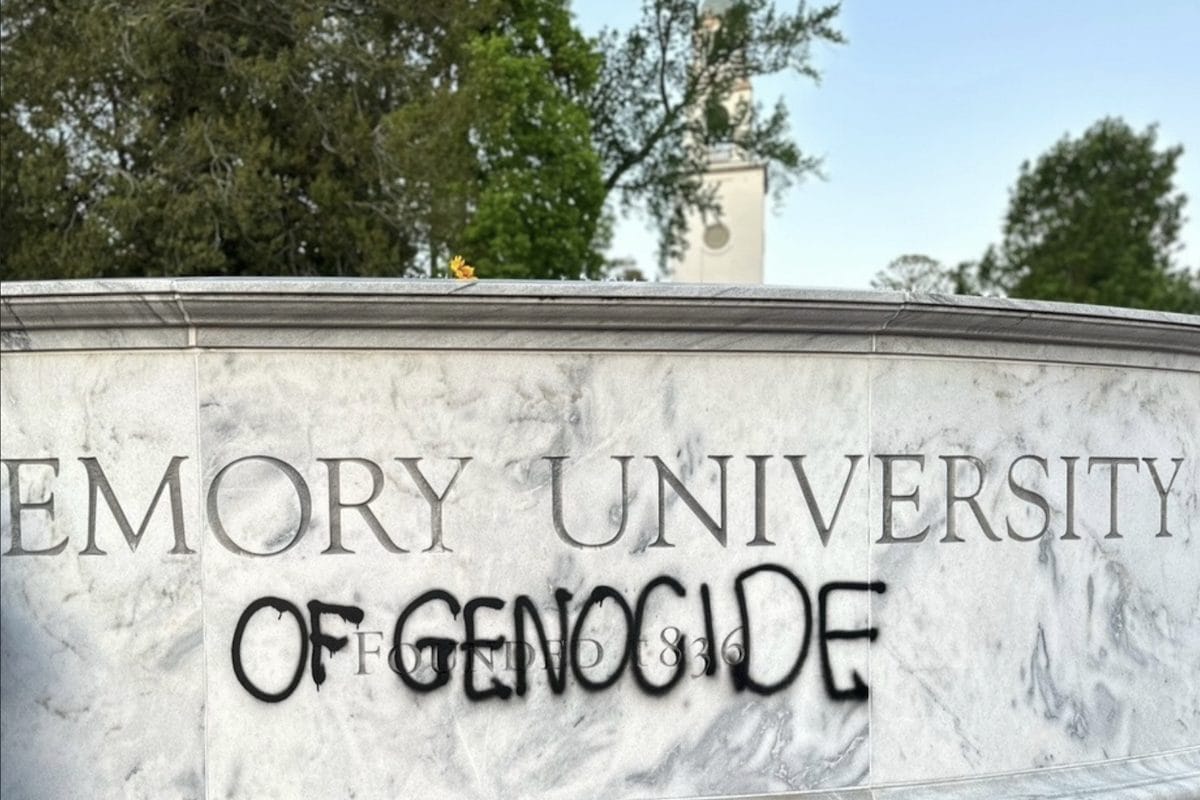
ATLANTA—One year ago today, Emory University and local police brutally suppressed a student-led Gaza solidarity encampment within hours of its establishment. Students, faculty, staff, and community members were violently arrested, tear gassed, tased, and shot with pepper bullets by Atlanta Police Department and Georgia State Patrol. The effects of this violence are still deeply felt in our community in the form of psychological trauma, ongoing court cases, and, in the case of medical student Umaymah Mohammad, retaliatory suspension.
Beyond Atlanta, the state continues to retaliate against students across the country who bravely denounced the U.S./Israel’s genocide against the Palestinian people. The recent visa cancellations and detention of student activists—including Mahmoud Khalil, Leqaa Kordia, Mohsen Madawi, and Rumeysa Ozturk—represent a continued effort by the federal government to crush the popular student movement for a free Palestine.
The wide net of detentions, visa terminations, and deportations also extends to people convicted of shoplifting, traffic violations, and victims of “administrative errors” who have not been accused of any crime. One Emory student and three Emory alumni have already had their student visas terminated by ICE. These actions are meant to sow fear and to discourage political organizing both on and off campuses.
In the face of these widespread fear tactics, we commit to supporting one another. When Emory is the source of repression—when it calls the police on campus protests, suspends its own students, and allows racism to flourish unchecked on its own campus—we vow to raise our voices against it. When Emory capitulates to federal directives—if it cuts DEI programs, allows ICE onto our campus, and hands over student information to government agencies—we will also raise our voices. Our fight against illegal detentions, police and military brutality, and attacks on political organizing continues, from Atlanta to Palestine.
The following is the full open letter from 55 Emory faculty and staff members:
Emory University should not be a campus where our students’ right to learn is predicated on their race, ethnicity, or religion. And yet, our students have come to us reporting a climate of discrimination. We may care for all students, but our ability to teach and mentor is being impeded by the university’s stifling of pro-Palestinian voices. This pattern is clearest in the racist targeting and suspension of Umaymah Mohammad, a Palestinian MD/PhD student.
In an April 2024 interview with Democracy Now!, Umaymah denounced Emory’s discrimination against Palestinians and its violence against pro-Palestine protesters. As a result of this interview, the Emory medical school retaliated against Umaymah through a string of illogical and discriminatory disciplinary trials that led to her one-year suspension. As Umaymah states in an editorial, she came to Emory University School of Medicine because she believed in its mission of “care” and “justice.” However, she says she has realized that “to be a physician who speaks out against structures of violence,” she is being punished for her commitment “to not just protect life on an individual level, but to tearing down systems that take life on a massive scale.”
Umaymah’s suspension is one of many instances of anti-Palestinian, anti-Arab, and anti-Muslim harassment on campus. In October 2024, the Emory School of Medicine also fired Palestinian physician and faculty member Dr. Abeer AbouYabis for a private social media post, which the Emory Committee for Open Expression cites as likely a violation of AbouYabis’s rights under the Respect for Open Expression section. Additionally, last spring, Muslim and Arab Emory students experienced levels of discrimination so severe that the Council on American-Islamic Relations (CAIR-Georgia) and Palestine Legal filed a Title VI complaint with the U.S. Department of Education’s Office for Civil Rights (OCR). The complaint says that “the University may have contributed to, and at a minimum, appears to have failed to respond promptly or effectively to a hostile environment based on race and national origin, including shared Palestinian, Muslim, and/or Arab ancestry.”
Corey Saylor, the Research and Advocacy Director at CAIR, stated that Emory—along with George Washington University and UCLA—have :set the standard for creating a thoroughly hostile and dangerous environment for anti-genocide students, faculty, and staff, especially Muslim and Palestinian community members.”
More broadly, Emory University has failed to denounce Campus Reform, a conservative American group that spread posters throughout campus in an effort to dox Emory faculty and students who were arrested on April 25 during the Gaza solidarity encampment. The same group stationed a van in front of Emory’s bookstore with a picture of Isam Vaid, Muslim Religious Life Scholar in the Emory University Office of Spiritual and Religious Life, leading to Vaid resigning from his position.
These are only a few public examples of a general culture of intimidation, repression, and retaliation by Emory University against its employees for speaking out against a genocide. In contrast, physician-faculty members still employed by Emory have openly served in the IDF during the genocide and have written articles justifying the targeting of civilians by Israel. The message is clear: Open Expression and free speech are not rights that are extended to Palestinian or pro-Palestine voices at Emory University.
Francesca Albanese, United Nations special rapporteur on Palestine, has encouraged medical professionals to “pursue the severance of all ties with Israel as a concrete way to forcefully denounce Israel’s full destruction of the Palestinian healthcare system in Gaza, a critical tool of its ongoing genocide.” Rather than severing ties with a genocidal regime, however, Emory has doubled down in its support of Israel and suppressed the Graduate Student Government Association’s (GSGA) support of the Boycott, Divestment, and Sanctions (BDS) movement. While the United States supplies arms to Israel, Emory has stifled campus opposition to the ongoing genocide and continues to dehumanize those who most resemble the victims. By silencing, repressing, firing, and suspending the voices on campus resisting the mass killings of Palestinians, Emory University facilitates, legitimizes, and perpetuates the U.S.-funded Israeli genocide in Gaza. Dr. Ghassan Abu Sitta calls this connection the “Genocide Enablement Apparatus” and articulates the way that Western institutions, particularly medical institutions, have played integral roles in justifying Israel’s annihilation of Gaza.
As faculty, staff, and healthcare workers, we reject Emory’s role in the genocide in Gaza and its blatant repression of pro-Palestinian political expression on campus. We strongly condemn Emory School of Medicine for their harassment of Palestinian MD/PhD Candidate Umaymah Mohammad. We condemn her unjust and illegitimate suspension and call for her immediate reinstatement.
We demand that Dean Sandra Wong and Dean Bill Eley of Emory School of Medicine drop the suspension charges against MD/PhD candidate Umaymah Mohammad.